Watching
Your first Muay Thai card
How to follow a Muay Thai bout as a first-time spectator: the eight limbs, the clinch, how strikes score, what the music tells you, and what to know first.
Hold a seat by the ring ↗Quick answer
Watch for clean blows from any of the eight weapons, fists, elbows, knees and shins, and for the clinch, where fighters lock up and trade knees instead of being pulled apart. Under amateur rules a strike scores only if it lands unblocked. The band speeds up as a bout heats up. Young fighters and betting are both part of the sport in Thailand, and it helps to know that before you go.
The art of eight limbs
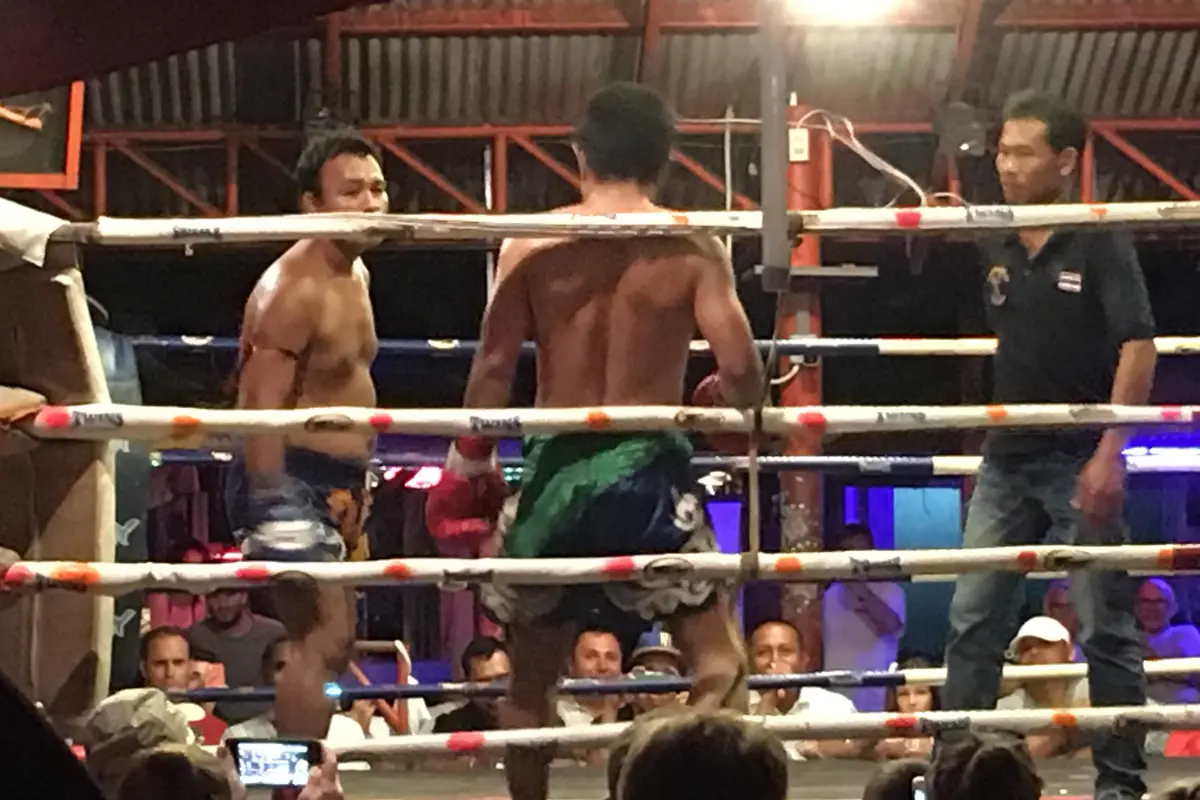
Strip it to basics and Muay Thai is stand-up fighting: strikes, sweeps and grappling in the clinch, with hands, elbows, knees and shins all in play, which is where the name art of eight limbs comes from. Anyone who practises it is a nak muay. Learn the Thai names and a bout gets easier to follow: muay mat for punches, sok for elbows, te for kicks, ti khao for knees, and the teep, a foot-thrust used mainly to control distance or block an attack. Fighters are taught to kick with the shin, not the fine-boned and much weaker foot, so watch the shins.
The clinch
Most newcomers are puzzled by the clinch. A boxing referee would part two fighters who hold each other; in Muay Thai nobody steps in, and the hold itself is where knees and elbows often land. The fighter on top locks both hands behind the back of the other's head and pushes it down. The way out is to force the head back, strike with an elbow, or slide an arm inside the hold to take control. When the crowd's noise rises as two fighters lock together, a knee exchange is usually under way.
Defence you can see
Defence is part of the show. Muay Thai uses a wall of defence: shoulders, arms and legs held to stop strikes landing cleanly. The most visible move is the check, in which a fighter lifts a shin to block a low or middle kick. Fighters also catch a kick to the body and sweep the standing leg, or counter a high kick with a low kick to the supporting leg. Punches are parried with small, precise movements of the glove. When a strike is blocked like this, it does not score, which is why the cleanest exchanges draw the loudest reaction.
How strikes score
Under the rules of the IFMA, the governing body for amateur Muay Thai, a strike earns a point only when it lands without being blocked; contact with the opponent's glove, forearm, shin or foot scores nothing. When a bout goes the distance with the scores level, victory goes to whoever landed the larger number of full-contact blows. That is why fighters work so hard to find an opening rather than simply throwing more, and why a clean exchange draws the loudest reaction from the crowd.
Rounds, gloves and the referee
Rounds, referees, gloves and the Western-style ring are relatively recent additions. They came in when King Rama VII modernised Thai boxing competitions in the 1920s and 1930s. Before that, fighters wrapped their hands and forearms in hemp rope, which protected the fists and made strikes more likely to cut. After a death in the ring, gloves and cotton coverings for the feet and ankles became standard. The music is older than the gloves: the sarama band in the corner slows for the salute and speeds up once a round begins.
Read next: Muay and the Lanna north
Young fighters
Thai cards often feature young fighters, and the bazaar ring's card runs from rising fighters to experienced ones. In 2016, 9,998 children under 15 were registered with the boxing board of the Sports Authority of Thailand, and some estimates put child boxers nationwide at 200,000 to 300,000. A study at Ramathibodi Hospital of 300 child boxers reported brain injuries and lower IQ scores than in children who did not box. Thai child-safety researchers have argued that under-15s should avoid head contact. You may decide this is something you would rather not watch, and that is a reasonable choice.
Betting and the crowd
Professional Muay Thai in Thailand has long been bound up with gambling. A Bangkok Post columnist once estimated betting on the sport at about 40 billion baht a year, and fixed fights are not unknown. Bangkok's army-run Lumpinee stadium, described as a symbol of modern Muay Thai, announced in 2021 an intention to ban gambling to attract a non-gambling audience. You will not be asked to bet at the bazaar ring, and nothing on your ticket involves a wager. The cheering will still rise and fall with every clean strike.
Read next: What happens before the bell
Sources